Chemistry Public Lectures
Each year, an expert from the School of Chemistry presents a public lecture about some of our latest research that is expanding our knowledge and helping to shape a brighter future.
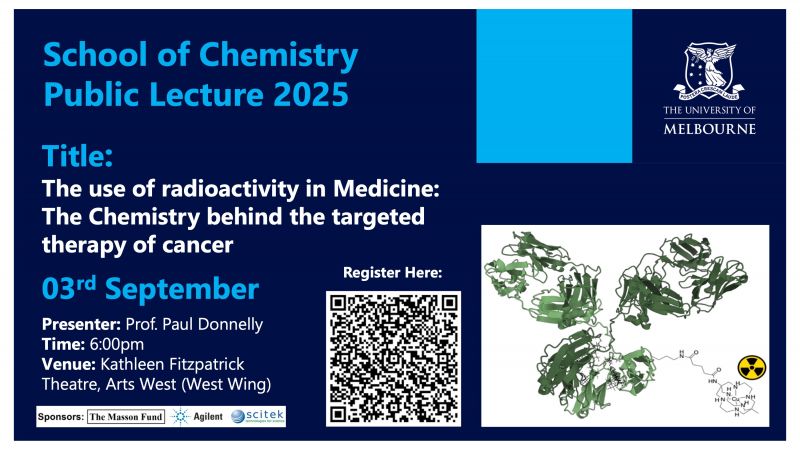
The use of radioactivity in Medicine: The Chemistry behind the targeted therapy of cancer
2025 School of Chemistry Public Lecture
Presented by Prof. Paul Donnelly
The University of Melbourne
This School of Chemistry Public Lecture will focus on the use of molecules that have been labelled with radioactive isotopes for diagnostic imaging and radionuclide therapy. Selectivity for cancer tissue is possible by incorporating metallic radionuclides into molecular cages that are attached to molecules that selectively bind to receptors that are over-expressed in tumours. A brief history on the use of radiation in medicine will be followed by a discussion of some of the latest research from the University of Melbourne that has been translated to human clinical trials.
There will be a reception after the lecture where there will be an opportunity to meet the speaker.
More information: https://events.unimelb.edu.au/chemistry/event/48198-the-use-of-radioactivity-in-medicine-the-chemistry
Register here via Eventbrite: https://www.eventbrite.com.au/e/radioactivity-in-medicine-the-chemistry-behind-targeted-cancer-theropy-tickets-1508715481619?aff=oddtdtcreator
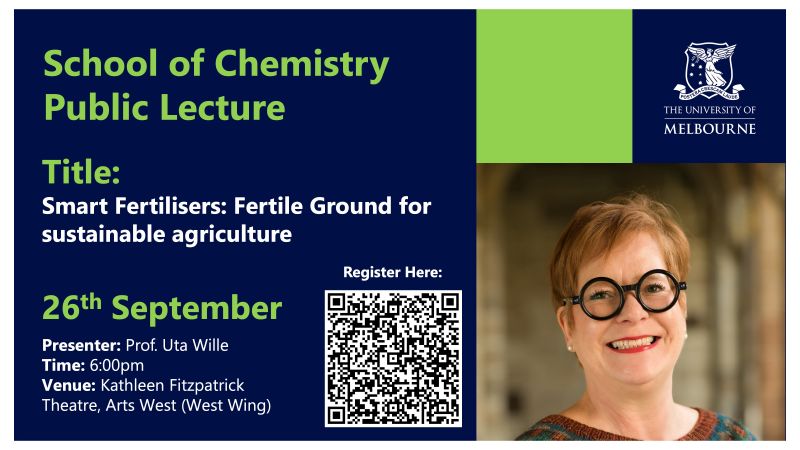
Smart Fertilisers: Fertile ground for sustainable agriculture
2024 School of Chemistry Public Lecture
Presented by Prof. Uta Wille, Deputy Head of School
The University of Melbourne
Modern farming practices require nitrogen fertilisers, with their use projected to increase by 70-100% by 2050. Unfortunately, approximately 50% of nitrogen fertilizers applied to agricultural systems is lost into the environment. These losses are not only expensive for farmers and consumers but, more importantly, the environmental impact is substantial: ammonia in nitrogen fertilisers is a precursor for particulate matter (PM2.5), while nitrate leaching causes excessive surface water eutrophication and groundwater pollution.
Microbial processes also play a role, converting nitrogen fertiliser into gases including nitrous oxide, which has 300 times higher global warming potential than carbon dioxide. Thus, to lower the greenhouse gas footprint of agriculture, reduction of nitrogen losses has become an important goal. This seminar will present a selection of strategies to improve nitrogen management in soils to increase agriculture’s sustainability.
Lost in space: Interstellar chemistry and the mystery of the diffuse interstellar bands
2023 School of Chemistry Public Lecture
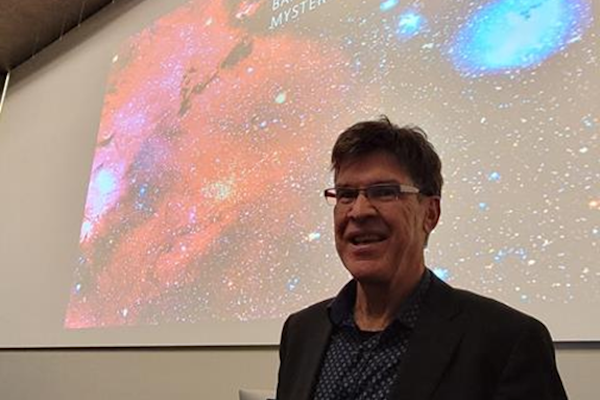
In 2023 the School of Chemistry launched the first public lecture of a new series that will run each year. Evan Bieske (pictured) presented an entertaining first lecture, titled, ‘Lost in Space: interstellar chemistry and the mystery of the diffuse interstellar bands’, to almost 200 people, and received plenty of positive feedback. See the Pursuit article by Samuel Marlton and Christopher Hall to learn more about the topic.
Uta Wille made an excellent MC for the event, which was preceded by the ever-popular Liquid Nitrogen Ice Cream show, thanks to Mick Moylan and the crew. Hit the ‘Follow’ button here to be informed of upcoming lectures. The next lecture will be given this year by Uta Wille on how to feed the world and save the environment at the same time with chemically advanced fertilisers. Keep an eye out for the lecture date when it is announced.